





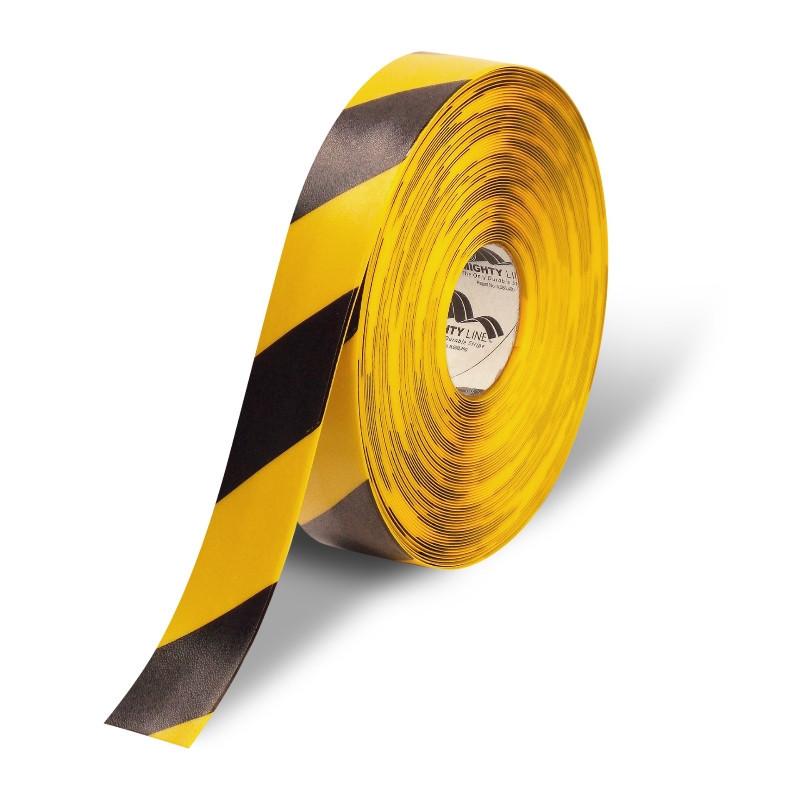

Yellow tape is commonly used to make warehouse aisles, traffic boundaries, work cells, staging areas, and caution-related locations easier to identify. It is highly visible on industrial floors, but its exact meaning depends on whether it is being used as a company visual standard or for a specific safety purpose.
In a 5S workplace, yellow is often the main color for general boundaries and traffic areas. OSHA also identifies yellow as the basic color for caution and certain physical hazards, so facilities should clearly define what each yellow marking communicates rather than assuming every yellow line means the same thing.
This guide explains where yellow floor markings are commonly used, whether yellow is required for warehouse aisles, which marking style works best for different applications, and how the color can fit into a broader 5S system.
What Does Yellow Floor Tape Mean?
Yellow floor markings can communicate different things depending on where and why they are installed.
In warehouse visual management, yellow is frequently used for main aisles, traffic lanes, production boundaries, staging areas, and other general divisions. The bright color provides strong contrast on many concrete floors, making boundaries easier to notice while workers and equipment are moving through the facility.
OSHA gives yellow another important meaning. Under 29 CFR 1910.144, yellow is the basic color for designating caution and marking physical hazards associated with risks such as striking against, stumbling, falling, tripping, and being caught between objects.
That does not mean every yellow line on a warehouse floor automatically represents an OSHA hazard marking.
A yellow line outlining a normal production cell may simply be part of the facility's internal 5S standard. A yellow marking near a physical hazard may have a specific caution purpose.
The best approach is to document your color system so employees understand the difference.
Where Is Yellow Commonly Used in Warehouses?
Yellow works especially well where employees need to recognize a boundary quickly.
Instead of using it everywhere, apply it to locations where high visibility adds useful information.
Main Aisles and Traffic Routes
One of the most familiar applications is a long warehouse aisle.
Continuous yellow floor lines can define where forklifts, pallet jacks, carts, or other material-handling equipment travel. When storage locations sit beside the route, the boundary also helps workers see where inventory should stop and the traffic area should begin.
For example, a warehouse could use yellow lines for the main travel lane and white corners for individual pallet positions beside it.
The colors and shapes then communicate two separate instructions without filling the floor with unnecessary markings.
Receiving and Staging Areas
Receiving areas can become disorganized quickly because material is constantly entering and leaving.
A clearly defined yellow boundary can establish the overall staging area so temporary pallets do not gradually spread into an aisle or workstation.
Individual pallet positions inside that zone can then use corners or T shapes.
This layered approach is often clearer than drawing a complete yellow rectangle around every pallet.
Work Cells and Production Areas
Production floors may use yellow boundaries to distinguish one work area from another.
A line around a work cell can show where machinery, carts, materials, and operators are expected to remain. If something sits outside the marked area, the abnormal condition becomes easier to spot.
This directly supports the visual-management side of 5S.
Caution and Physical Hazard Areas
Yellow also has a formal caution role under OSHA's safety color standard. When a location involves a physical hazard covered by applicable safety requirements, the color may help draw attention to that condition.
Floor markings should still be treated as one part of the safety system. They do not replace required guards, barriers, signs, procedures, or employee training.

Yellow Floor Marking Uses at a Glance
The best marking format depends on the message employees need to understand.
|
Application |
What the Marking Communicates |
Recommended Format |
Why It Works |
|
Main aisle |
Travel area begins and ends here |
Continuous yellow lines |
Easy to follow across long distances |
|
Forklift route |
Material-handling traffic path |
Lines with directional arrows |
Shows both boundary and movement |
|
Work cell |
Operational area boundary |
Continuous line |
Makes cell limits visible |
|
Staging zone |
Temporary materials belong here |
Boundary plus position markers |
Prevents staging from spreading |
|
Pallet position |
Place one pallet here |
Corners or T shapes |
Uses less marking than a full box |
|
Physical hazard |
Increased caution is required |
Application-specific marking |
Draws attention to the condition |
This is why choosing a marking should start with the message rather than the product.
If workers need to follow a route, a continuous line usually makes sense.
If they only need to know where a cart should be parked, four corners can often do the job with less material.
Is Yellow Required for Warehouse Aisles?
Yellow is common for warehouse aisles, but it should not be presented as a universal requirement for every aisle.
OSHA interpretation material addressing aisle and passageway markings explains that painted yellow lines are not the only acceptable way to identify permanent aisles. Other appropriate methods can be used depending on the workplace and conditions.
An older archived OSHA interpretation also stated that aisle lines could be another color as long as the aisle area was clearly defined. Because OSHA identifies that document as archived material that may no longer represent current policy, it is useful as historical context rather than a standalone current requirement.
So why is yellow still so common?
Visibility and familiarity are major reasons.
Yellow stands out against gray concrete and already carries a strong caution association. Using it consistently for major traffic boundaries can therefore make a warehouse layout easier to understand.
The important point is this:
Common practice and legal requirement are not always the same thing.
Facilities should review the standards that apply to their operation and hazards rather than treating a general 5S color chart as an OSHA regulation.
How Yellow Fits Into 5S
5S is commonly organized around Sort, Set in Order, Shine, Standardize, and Sustain.
Floor markings are particularly useful during Set in Order and Standardize because they make expected locations visible.
The Floor Tape Store guide to 5S and lean workplace organization explains the broader methodology.
When building the floor system itself, the objective is simpler.
Each color should answer a workplace question.
For example:
Yellow can show where a primary aisle or boundary belongs.
White can distinguish ordinary equipment or pallet positions.
Another color can communicate material status, inspection, safety equipment, or another category your facility regularly needs to recognize.
The system should be easy enough that employees do not need to memorize a complicated chart every time they enter another department.
A Practical 5S Color-Coding Example
There is no single universal color chart that every warehouse must copy.
A practical internal standard might look like this:
|
Color |
Example Facility Meaning |
Best Application |
|
Yellow |
Main aisles and general boundaries |
Traffic lanes, cell boundaries, staging areas |
|
White |
Equipment and storage locations |
Racks, carts, pallet positions |
|
Green |
Facility-defined approved or safety-related area |
Finished material or designated locations |
|
Red |
Facility-defined restricted, scrap, or safety category |
Areas requiring clear separation |
|
Blue |
Work in process |
Material-status zones |
|
Orange |
Inspection or hold |
Quality-control staging |
|
Black/Yellow |
High-attention caution marking |
Selected hazard or caution boundaries |
This table is an example of a visual-management system, not a claim that OSHA mandates every assignment shown above.
OSHA's specific rule states that yellow is the basic color for caution and certain physical hazards. It does not establish one mandatory 5S color assignment for every warehouse rack, material category, pallet, workstation, and storage zone.
For a broader approach, Floor Tape Store's guide to a color-coded warehouse floor can help you connect yellow with the rest of the facility's visual system.
Which Yellow Floor Marking Type Is Best?
Color tells employees what category they are looking at. Shape tells them what they are supposed to do with that information.
That distinction makes product selection easier.
Continuous Tape for Long Boundaries
Continuous floor tape is usually the best option when people need to follow a line.
Typical applications include main aisles, staging boundaries, long work-cell edges, and traffic lanes.
The floor tape collection includes options for different industrial applications, so the final choice should consider more than color alone.
Traffic level, floor condition, temperature, cleaning methods, and the frequency of layout changes all matter.
Corners and T Shapes for Positions
A complete taped rectangle is not always necessary around a pallet or cart.
Corners can show exactly where an individual object belongs while leaving most of the floor uncovered.
T shapes are particularly useful when pallet positions sit beside each other because one center marker can help divide neighboring locations.
The 5S markings collection provides position markers and directional shapes that can complement long floor lines.
Arrows When Direction Matters
A boundary tells employees where a route exists.
An arrow can tell them which way to travel.
For one-way material flow, intersections, or directional warehouse routes, combining the two can communicate more information without adding another color.
Solid Yellow vs. Yellow and Black: Which Should You Use?
This is an important buying distinction because the two styles create different visual impressions.
Solid yellow is generally the cleaner choice for ordinary visual-management boundaries.
It works well for main aisles, work cells, staging areas, and other locations where the message is simply "this is the boundary."
Yellow-and-black striping creates a stronger caution-style appearance.
That makes it more appropriate when you intentionally want a location to receive additional attention because of the nature of the area or hazard.
When yellow tape is being selected for a new floor system, ask what the line needs to communicate before deciding between solid and striped material.
For a normal warehouse aisle, solid yellow may provide all the visibility you need.
For an area that must look visually distinct from ordinary boundaries, a striped pattern may make more sense, subject to the safety requirements that apply to the location.

How to Build the System Without Overusing Yellow
A common mistake is making every marking the same color.
At first, that seems consistent.
Over time, however, the floor becomes harder to read because a pallet location, main aisle, workstation, and caution area all look identical.
Instead, establish a hierarchy.
Use yellow for the largest or most important general boundaries your facility has assigned to that color.
Then use other defined colors and shapes only when they communicate a genuinely different category.
This allows workers to recognize information in layers.
They see the main traffic layout first.
Then they see individual equipment, inventory, or process locations.
The result is a visual system rather than a collection of unrelated lines.
How Much Floor Tape Do You Need?
For long lines, calculate linear footage before ordering.
Suppose an aisle is 100 feet long and requires a boundary on both sides.
100 feet × 2 = 200 feet of line.
Then add an allowance for cuts, repairs, corners, and installation adjustments.
Position markers should be calculated differently.
If ten independent carts each require four corner markers, the basic quantity is 40 corners.
A row of adjoining pallet positions may use a combination of outside corners and center T markers instead, which can reduce the number of separate pieces required.
Measuring this way also helps prevent buying large quantities of one color before you have tested whether the layout actually works.
Test One Area Before Marking the Entire Facility
Start with a location that regularly causes confusion.
A receiving area is often a useful test because it combines traffic, temporary material storage, and frequent movement.
Install the proposed boundary and position markers, then watch how employees interact with the area during normal work.
Do pallets remain inside the intended staging space?
Can forklifts follow the route naturally?
Do workers understand the meaning without stopping to ask?
If employees repeatedly cross a line because the real process requires it, changing the workflow or layout may be more useful than adding more markings.
This is an important part of 5S.
The goal is not to make the floor look organized in a photograph. The goal is to make daily work easier to understand and maintain.
How Yellow Should Connect With the Rest of the Color System
Once the main yellow boundaries are established, use the rest of the color system to answer narrower questions.
A simple warehouse might need only three or four colors.
A larger manufacturing operation may need additional categories for work in process, inspection, scrap, equipment, finished goods, and special operational areas.
The key is consistency.
A color should not mean "inspection hold" in one department and "approved inventory" in another unless there is a clear reason and employees are trained accordingly.
Create a facility legend, post it where workers can reference it, and include the meanings in onboarding or relevant safety and process training.
This keeps the color system connected to actual workplace behavior instead of turning it into decoration.

Common Yellow Floor Marking Mistakes
The first mistake is assuming employees automatically know what the color means.
Even familiar colors should be documented.
The second is using long continuous lines where position markers would communicate the location more efficiently. A cart does not always need a full taped box around it.
Another problem is choosing a product entirely by price or color without considering floor conditions and traffic. A lightly used stockroom and a forklift-heavy distribution area can place very different demands on a marking.
Finally, avoid presenting your internal color standard as if every part of it were an OSHA requirement.
OSHA does specify yellow for caution and certain physical hazards, but that is different from saying every warehouse aisle, staging area, or 5S boundary must use the same color.
Final Thoughts: Choosing Yellow Floor Markings That Make Sense
A strong warehouse color system begins with a clear purpose.
Use long yellow lines when employees need to recognize and follow a boundary. Use corners or T shapes where the real message is "this object belongs here." Add arrows when movement needs to be obvious, and reserve stronger caution-style visuals for situations where that additional distinction is useful and appropriate.
Most importantly, connect every marking to one documented facility meaning.
Yellow tape works best when employees can look at it and immediately understand what the boundary is telling them to do. A simple, consistent system will usually provide more value than filling the warehouse with additional colors and lines that no one can easily explain.
Frequently Asked Questions
What does yellow floor tape mean?
Yellow floor markings commonly communicate major boundaries, traffic areas, or caution-related information. In 5S systems, facilities often use the color for aisles, staging boundaries, work cells, and other general divisions because it is highly visible. OSHA also identifies yellow as the basic color for caution and for marking certain physical hazards. The exact meaning therefore depends on the application, which is why companies should document their internal floor-marking standard.
Where is yellow floor tape commonly used in warehouses?
Common applications include forklift aisles, main traffic lanes, receiving and shipping zones, staging areas, work-cell boundaries, and other spaces that require a strong visual edge. Continuous lines generally work best for long boundaries, while corners and T shapes can define individual pallets, carts, or equipment locations more efficiently. The best application is the one that solves a specific movement, storage, or visual-management problem rather than simply adding more color to the floor.
Is yellow required for aisles?
Yellow should not be described as universally required for every warehouse aisle. OSHA interpretation material explains that painted yellow lines are not the only method that may be used to identify permanent aisles and passageways where marking is needed. Other appropriate approaches can be acceptable depending on workplace conditions and employee training. Facilities should review the standards applicable to their operation instead of assuming an industry convention is automatically a legal requirement.
How does yellow fit into a 5S color-coding system?
Yellow often works well as the anchor color for major traffic routes and general boundaries, while other colors identify narrower categories. A facility might use white for equipment locations, blue for work in process, or another documented color for inspection status. The strongest systems keep the number of meanings manageable and use the same definitions across departments. This makes Set in Order and Standardize easier to maintain because the floor itself helps communicate where people, materials, and equipment belong.